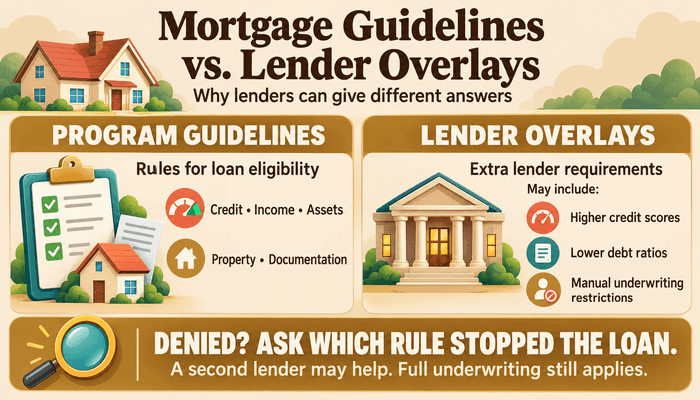
Mortgage guidelines versus overlays come down to who sets the requirement. Mortgage guidelines are the basic rules established by agencies and loan programs such as FHA, VA, USDA, Fannie Mae, and Freddie Mac. Lender overlays are additional requirements that a bank or mortgage company chooses to add on top of those minimum guidelines.
This is why one lender may deny a borrower while another may approve the same loan. A lender might require a higher credit score, lower debt-to-income ratio, stronger reserves, or stricter underwriting, even when the borrower meets the underlying program guidelines.
Being turned down by one lender does not always mean you are ineligible for the mortgage program. It may simply mean that a particular lender has additional requirements.
What Is the Difference Between Mortgage Guidelines and Lender Overlays?
Mortgage Program Guidelines
Mortgage guidelines include eligibility, documentation, and underwriting requirements. They cover credit history, verified income and assets, debt calculations, occupancy, and property eligibility. Requirements can also differ between automated and manual underwriting. FHA, VA, and USDA establish requirements for their government-backed mortgage programs. Fannie Mae and Freddie Mac are enterprises sponsored by the government that set eligibility standards for the mortgages they buy or guarantee. Having the right credit score or down payment is not enough to qualify. The lender also needs to verify your information and ensure your application complies with all agency and program rules.
Lender Overlays
Lender overlays are additional restrictions that go beyond the applicable program requirements. A borrower may need to have a higher credit score, additional reserves, or a lower debt-to-income ratio. It may also decline to offer an underwriting option that the program permits. An overlay goes beyond the applicable program requirements for that particular loan. An underwriter’s request for additional documents does not automatically mean an overlay applies. Additional pay stubs may be needed to verify income, or an explanation and supporting records may be needed to establish the source of a deposit. These conditions can be part of satisfying the program’s documentation and underwriting standards.
Example: A VA Credit Score Overlay
Suppose a veteran has a 600 credit score, but a lender requires at least 620 for VA loans. The VA does not set a minimum credit score standard, so the lender’s requirement of 620 is an additional condition. VA still requires the lender to evaluate the borrower’s credit history and ability to repay. The borrower’s next step is to determine whether another lender will accept that credit profile and whether the rest of the application meets VA requirements.
Why Mortgage Lenders Add Overlays
Mortgage lenders use overlays to control risk. A lender may decide that certain loans carry more credit, operational, investor, or repurchase risk than it is willing to accept. Overlays may also reflect the lender’s business model, funding source, investor requirements, or appetite for more complex loans. For example, some lenders may choose not to offer manual underwriting even when the loan program permits it. Others may require stronger credit or lower debt ratios for borrowers with recent bankruptcies or other higher-risk characteristics.
Overlays Can Change
Lender overlays are not necessarily permanent. A mortgage company can tighten or loosen its internal requirements as market conditions, investor relationships, or risk policies change. That is another reason borrowers should not assume that one lender’s requirements apply everywhere.
A Denial Does Not Always Mean the Loan Is Ineligible
When a loan is declined, it is important to identify the actual reason. If the borrower fails to meet the underlying program guidelines, moving the loan to another lender may not solve the problem. If the issue is a lender overlay, another lender with different requirements may be able to consider the same borrower. That does not guarantee approval. The entire loan must still meet the applicable program guidelines and pass the lender’s underwriting review.
Common Types of Mortgage Overlays
Mortgage overlays can affect almost any part of a loan file. Some are minor, while others can completely change whether a lender will accept the loan. The most common overlays involve credit, debt ratios, manual underwriting, recent credit events, and property eligibility.
Credit Score Overlays
A lender may require a higher credit score than the underlying loan program requires. For example, a loan program may permit a borrower with a lower score, while the lender sets its own minimum at 620, 640, or another level.
Debt-to-Income Overlays
Some lenders set their own limits on debt-to-income ratios, even when the automated underwriting system or loan program allows a higher ratio. This can affect borrowers with high income but significant monthly obligations.
Manual Underwriting Overlays
A loan program may allow manual underwriting, but not all lenders offer it. This can affect borrowers who receive a Refer recommendation from an automated underwriting system or who need a manually underwritten loan because of their credit history or other circumstances.
Credit Event and Property Overlays
Lenders may also have additional restrictions involving:
- Bankruptcy
- Foreclosure
- Collections or charge-offs
- Manufactured homes
- Condominiums
- Multi-unit properties
- Non-occupant borrowers
The important point is that these restrictions may come from the lender rather than the mortgage program itself.
What Does “No Lender Overlays” Actually Mean?
 “No lender overlays” means a lender follows the applicable agency and program requirements without adding stricter restrictions within the stated scope. Ask which loan program, transaction, and requirements the claim covers. For example, following FHA’s credit-score requirements does not establish whether that lender offers manual underwriting or accepts your particular property type.
Confirm What Is Available for Your Loan
Before applying, ask:
- Does the claim cover the loan program and transaction I need?
- Are there additional restrictions on credit scores, debt ratios, reserves, or credit history?
- Does the lender offer manual underwriting when the program permits it?
- Does it accept my property type, including any applicable manufactured-home or condominium requirements?
The answers should reflect the requirements of the lender that would fund your loan.
Program Requirements Still Apply
Borrowers must still document their income, assets, debts, and credit history. The property must meet applicable eligibility and appraisal requirements, and the lender must complete its underwriting review. A lender without overlays can still decline an application that fails to satisfy those requirements. “No overlays” does not guarantee approval.
How a Mortgage Broker Reviews Your Options
A mortgage broker can help borrowers compare mortgage options among lenders. The broker may have company policies governing which applications it accepts, while each wholesale lender has its own underwriting requirements. To review your situation with Gustan Cho Associates, please share your preferred loan program, credit profile, income, monthly debts, available funds, property type, and any reasons for past loan denials. This information helps the loan officer assess how your case aligns with current wholesale lender requirements. The review will show if a wholesale lender might consider your case, which underwriting options are available, and what steps are needed before you can get approved.
What to Do When a Lender Denies Your Mortgage
A mortgage denial gives you a problem to investigate. Before submitting another application, follow these steps to identify what stopped the loan and whether it can be resolved.
1. Review the Denial Notice
For a formal credit denial, the adverse-action notice generally states the specific reasons or explains your right to request them. If the reasons are missing, follow the notice’s instructions for obtaining them. The CFPB’s notification rules explain these requirements. Keep the notice and any related communications from the lender for your next review.
2. Ask Where the Requirement Comes From
Ask your loan officer whether the problem involves an agency or program requirement, a lender overlay, or an investor restriction. A denial reason, such as excessive debt obligations, may identify the problem without explaining whose debt ratio limit applies. That distinction requires a follow-up question. If the issue is an underlying program requirement, another lender must still apply it to the same program and transaction.
3. Find Out Whether the File Can Be Corrected
Ask whether missing documents, incorrect application information, or unresolved questions caused the denial. Additional income records or documentation supporting a deposit may resolve some concerns. Have the lender explain what information is needed and whether it can reconsider the application after reviewing it. If the file does not meet program requirements, discuss whether a different loan structure or program is appropriate.
4. Request a Review of the Exact Issue
Before starting another full application, tell the second lender why the first lender declined the loan. Provide the denial notice and the relevant facts about your credit, income, debts, available funds, and property. Ask whether the second lender accepts that specific scenario and what conditions would apply. Its willingness to consider the issue still requires a review of the complete file.
5. Check the Effect on Your Closing
Before changing lenders, confirm:
- Whether the new lender can meet your contract’s closing deadline.
- Whether the existing appraisal can be transferred and accepted.
- Which fees, if any, you may need to pay again.
- What interest rate and rate-lock terms the new lender offers.
Do not assume the original lender’s rate lock carries over. Discuss any needed deadline changes with your real estate agent before committing to the move.
Low Credit, High DTI, or Manual Underwriting? You May Have Options
Borrowers with challenging credit or complex files often need a lender that is comfortable underwriting closer to the actual program guidelines.FHA Guidelines Versus FHA Lender Overlays
FHA loans are insured by the Federal Housing Administration and follow HUD requirements. Individual lenders can still add their own underwriting standards. One of the most common examples involves credit scores.
HUD permits FHA financing with a 3.5% down payment for borrowers with credit scores of 580 or higher. Borrowers with scores from 500 through 579 generally require at least a 10% down payment under the FHA minimum requirements.
A lender may still decide not to approve FHA loans with scores below 620 or another internally established threshold. That higher score requirement is a lender overlay.
FHA Manual Underwriting: How to Identify a Lender Restriction
Hypothetical example: An FHA borrower receives a Refer recommendation through an automated underwriting system using FHA’s TOTAL Scorecard. The first lender declines to proceed. What stopped the application: The lender accepts only FHA loans with an acceptable automated recommendation and does not offer manual underwriting. How the restriction was identified: The loan officer checks the lender’s current FHA program matrix and confirms that it excludes manually underwritten loans. This identifies a published lender restriction. Supplying another pay stub would not, by itself, remove that restriction. What another lender could consider: A wholesale lender that offers FHA manual underwriting could evaluate the application under HUD’s manual underwriting requirements. HUD’s TOTAL guidance states that a Refer result requires review by an FHA Direct Endorsement underwriter; the lender cannot deny the mortgage solely based on TOTAL’s assessment. What still needs to be satisfied: The second lender must verify qualifying income, review payment history, document acceptable funds for closing, and confirm that the debt ratios, applicable reserves, and property meet FHA requirements. This illustrates the difference between a lender declining an underwriting path and an underwriter requesting information needed to evaluate the borrower. Identifying which problem applies helps determine whether additional documentation or a different lender is the appropriate next step.
FHA Collections and Other Credit Issues
FHA does not automatically require every collection account to be paid in full. However, outstanding collections can still affect qualification depending on the type of account, total balance, debt-to-income calculation, and underwriting requirements. A lender may also have an overlay requiring certain collections or other derogatory accounts to be resolved, even when HUD does not require payment in full.
VA Guidelines Versus VA Lender Overlays
VA loans provide one of the clearest examples of the difference between agency guidelines and lender overlays. The Department of Veterans Affairs does not establish a universal minimum credit score for VA loans. Individual lenders often do. A lender may require a credit score of 580, 600, 620, or higher before approving a VA loan, even though those scores are not minimums established by VA. That is a lender overlay.
VA Debt-to-Income Overlays
VA underwriting places significant importance on residual income rather than relying only on a single maximum debt-to-income ratio. Some lenders still impose their own DTI limits, particularly on borrowers with weaker credit or other risk factors. A borrower with high residual income may therefore meet VA requirements but still be declined by a lender with a stricter internal debt-ratio policy.
VA Manual Underwriting
VA permits manually underwritten loans when the file meets applicable VA requirements. Not every lender offers VA manual underwriting. This is especially important for borrowers with recent credit problems, limited traditional credit, or other circumstances that prevent an automated approval.
USDA Guidelines Versus USDA Lender Overlays
USDA loans are designed to help eligible borrowers purchase homes in qualifying rural areas. The loan must meet USDA requirements for income, property eligibility, occupancy, credit, and repayment ability. Lenders may still add additional standards. Common USDA overlays can involve:
- Minimum credit scores
- Debt-to-income ratios
- Credit history
- Manual underwriting
- Collections or recent late payments
USDA Credit Score Requirements
USDA underwriting does not always work as a simple universal minimum-score rule. Credit scores can affect automated underwriting and the level of documentation or review required. A lender may nevertheless set its own minimum credit score for all USDA borrowers. Borrowers should therefore distinguish between a USDA requirement and a lender’s internal credit policy.
USDA Manual Underwriting
USDA permits manual underwriting in certain situations when the borrower meets the applicable requirements. Some lenders restrict or decline USDA manual underwriting altogether. A borrower who does not receive an automated approval may still have options, but the lender must be willing to underwrite the loan manually.
Fannie Mae and Freddie Mac Guidelines Versus Lender Overlays
Conventional loans are commonly underwritten through Fannie Mae’s Desktop Underwriter or Freddie Mac’s Loan Product Advisor. These automated underwriting systems evaluate the complete loan profile and provide an underwriting recommendation. A lender can still apply additional requirements after receiving an acceptable AUS recommendation.
Conventional Credit Score Overlays
Fannie Mae and Freddie Mac requirements depend on the transaction, underwriting method, and complete loan profile. A lender may impose a higher minimum credit score than the applicable agency or AUS requirements. This can affect borrowers who otherwise receive an acceptable automated underwriting recommendation.
Conventional Debt-to-Income and Reserve Overlays
A lender may also limit debt-to-income ratios or require additional reserves beyond what the AUS findings require. These overlays are more common when the borrower has several risk factors, such as:
- High DTI
- Limited reserves
- Recent credit problems
- Multiple financed properties
- Complex income
Does an AUS Recommendation Override Lender Overlays?
No. An acceptable recommendation from an automated underwriting system (AUS) does not override lender overlays or replace the lender’s underwriting review.
Fannie Mae’s Desktop Underwriter (DU) and Freddie Mac’s Loan Product Advisor (LPA) are automated underwriting systems. FHA TOTAL is a mortgage scorecard accessed through an AUS, not an AUS itself. HUD’s TOTAL guidance states that lenders cannot approve or deny an FHA mortgage solely on the scorecard’s assessment.
The lender is required to review the income, assets, debts, and credit information used to obtain the recommendation. It also has to verify that the property is eligible and meets the conditions set by the relevant agency, program, and lender. A recommendation that is accepted based on incomplete or inaccurate information does not constitute final approval. The lender might have to amend the application details and resubmit the file if there are changes to the loan or if new information is discovered. In some cases, depending on the situation, a manual review or a mandatory downgrade to manual underwriting may be required, even if an earlier recommendation was considered acceptable.
When Changing Lenders May Make Sense
A second opinion may be worth considering when the denial is based on a lender-specific requirement rather than on a rule of the loan program itself. This can be especially relevant with borrowers who have:
- Lower credit scores
- High debt-to-income ratios
- Manual underwriting
- Recent bankruptcy
- Recent foreclosure
- Prior mortgage late payments
- Collection accounts
- Nontraditional credit
- Complex income or property issues
The goal is not to find a lender that ignores underwriting rules. It is to find one whose lending requirements fit the borrower’s actual circumstances.
Final Thoughts on Mortgage Guidelines Versus Overlays
Understanding mortgage guidelines versus overlays can help borrowers make sense of conflicting answers from different lenders.
FHA, VA, USDA, Fannie Mae, and Freddie Mac establish the basic requirements for their respective mortgage programs. Individual mortgage lenders can then add their own standards based on risk, investors, and company policy.
That is why being denied by one lender does not always mean the borrower is ineligible for the loan program. The most important step is determining whether the problem stems from the program guidelines themselves or a lender-specific overlay. Once that is clear, the borrower and loan officer can determine whether the issue can be corrected, whether another loan program makes more sense, or whether another lender may be able to consider the file.
FAQs About Mortgage Guidelines and Lender Overlays
Are Mortgage Overlays Legal?
Yes. Mortgage lenders are generally permitted to set underwriting standards stricter than a loan program’s minimum requirements, as long as those policies comply with applicable lending and fair housing laws. Lenders use these additional standards to manage credit risk, investor requirements, and the types of loans they are willing to originate.
Are Mortgage Overlays the Same for Every Borrower?
Not necessarily. Some overlays apply to all borrowers in a given program, while others apply only when specific risk factors are present. For example, a lender may have additional requirements for borrowers with recent late payments on a mortgage, limited reserves, a prior bankruptcy, or a more complex property type.
Can Mortgage Overlays Affect the Interest Rate?
An overlay and an interest-rate adjustment are not the same thing. An overlay determines whether the lender will approve a specific type of loan. Pricing adjustments affect the mortgage interest rate or cost based on factors such as credit, loan-to-value ratio, property type, or loan structure. A borrower can meet a lender’s underwriting requirements and still receive different pricing based on the overall loan profile.
Can Lender Overlays Change After I am Preapproved?
They can. Lenders and investors may update credit policies, underwriting requirements, or eligible loan programs. A preapproval is based on the information and lending requirements available at the time it is issued. The loan still needs to meet applicable requirements through final underwriting and closing.
Can a Lender have Different Overlays for Different Loan Programs?
Yes. A lender may be comfortable with certain FHA loans but have tighter requirements for VA, USDA, conventional, manufactured housing, or other loan types. The lender’s risk tolerance and investor relationships can vary from one mortgage program to another.
This article about “Mortgage Guidelines Versus Overlays: Why One Lender May Approve You and Another Won’t” was updated on October 2nd, 2026.